As well as reporting on global IT threats, Kaspersky Lab also presented statistics for the Middle East in the first quarter of 2014 based on data from Kaspersky Security Network.
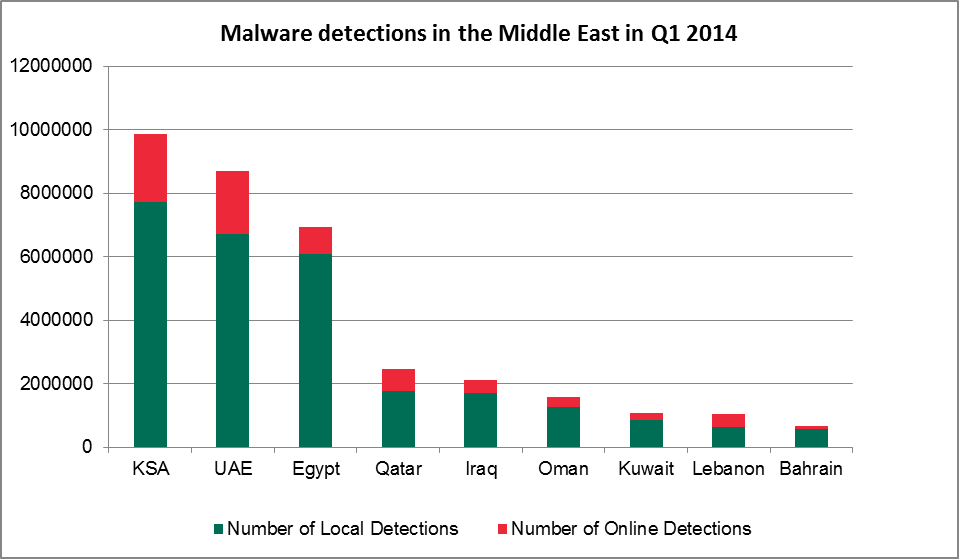
As well as reporting on global IT threats, Kaspersky Lab also presented statistics for the Middle East in the first quarter of 2014 based on data from Kaspersky Security Network. The Kingdom of Saudi Arabia has the highest total number of local and online malware detections, closely followed by the United Arab Emirates. Bahrain and Lebanon were the safest countries, according to these statistics, with the region’s lowest threat levels.
Altogether in the first quarter of 2014 in the Middle East Kaspersky Lab products neutralized more than 34.9 million cyber-attacks and malware infections on computers and mobile devices, representing an increase of almost 10% year-on-year (2013’s figure was 31.6 million). More than 7 million of these came from the Internet, while the remaining were blocked when they came from local sources such as USB drives, DVDs etc. These security incidents represent 3% of the global total.
“While mobile and financial malware, distributed denial of service, web threats and advanced persistent threats are becoming more popular among cybercriminals, removable media and local networks are still the primal sources of IT dangers for users in the Middle East. Companies and home users should be aware of those risks and to care of their data, using comprehensive solutions to keep safe,” said Ghareeb Saad, Senior Security Researcher at Kaspersky Lab.
Saudi Arabia suffered the greatest number of reported incidents, with 9.8 million attacks were blocked. Almost 80% of those were local threats. 43.8% of Saudi’s computer users were affected by malware on USBs, DVDs and local networks, while 28.1% faced online threats. UAE followed with 8.7 million incidents detected, 1.97 million of which were online threats (26.7% users were affected by them, while 42.6% faced local threats).
Regional Kaspersky Security Network statistics show that Iraq had the region’s highest percentage of users who faced web threats - 35%. Egypt had the highest level of local infection with 51.3%, though the online risks were moderate in the country – 24.3% of users were influenced.
Bahrain and Lebanon have the fewest malware detections in the region as well as the lowest percentage of people affected - only 17.7% and 15.3% of users faced Internet-borne threats respectively, and 34.5% and 34.9% of users experienced local attacks. They are safest countries in the Middle East in terms of IT threats.
The most popular malware used by cybercriminals in the first quarter in the region - the Dinihou Worm - made about 1 million infections. It spreads through removable media devices making use of .LNK files. The most frequently exploited vulnerabilities were breaches in Media Player Classic.
Kaspersky Lab’s global report on the evolution of IT threats in the first quarter of 2014 can be found online at: http://www.kaspersky.com/about/news/virus/2014/Q1-2014-Mobile-Banking-Trojans-Double-Surge-Bitcoin-Wallet-Attacks-Cyber-Espionage-Back-From-Dead
A cyberthreat real-time map is available at http://cybermap.kaspersky.com/


