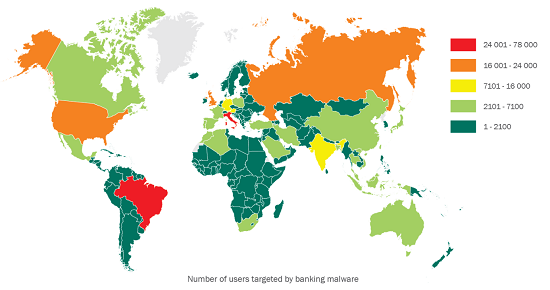
Users in Brazil, Russia and Italy were most frequently attacked by financial malware, according to Kaspersky Lab’s latest monthly report on online threats in the banking sector
In its report on online threats in the banking sector Kaspersky Lab informs about an increase in malware capable of stealing money from users of online banking accounts. In the reporting period from April 19 to May 19, 2014, Kaspersky Lab solutions blocked 341,216 attempts on computers to launch such malware. This figure represents a 36.6% increase compared to the previous month. More than a third of the total number of users attacked by banking malware were in Brazil, Russia and Italy. This increase in banking malware activity is most likely related to the onset of the vacation season, when customers actively use their payment data to make all types of purchases online.
As a rule, cybercriminals try to steal users’ bank card details with the help of the specialized Trojan programs. From mid-April to mid-May, Zeus (Trojan-Spy.Win32.Zbot) was once again the most widespread banking Trojan. According to Kaspersky Lab’s research, the program was involved in 198,200 malware attacks on online banking clients. About 82,300 people were attacked by Trojan-Banker.Win32.ChePro and Trojan-Banker.Win32.Lohmys – malicious programs mainly spread via spam emails with the subject “Internet bank charges”.
Yet another method of stealing banking data is phishing attacks. During the reporting period, Kaspersky Lab solutions blocked 21.5 million of these attacks and almost 10% of them (about 2 million) targeted users’ bank card details.
The reporting period was marked by consequences of one particular event that seriously jeopardized the security of online payment systems, namely a vulnerability previously found in the popular encryption library OpenSSL. The bug allows attackers to gain unauthorized access to the buffer memory of a vulnerable device, be it a smartphone, personal computer or server. The Heartbleed vulnerability leaves no trace and it is still not known what data was stolen and in what volumes. However, most companies that performed online transactions using the vulnerable version of OpenSSL have recommended that their clients change their account passwords and closely monitor any unusual activity.
“The appearance of the Heartbleed vulnerability initiated a series of leaks of all kinds of data in various business fields. This was due to the fact that this vulnerability contained the cryptographic OpenSSL library which is used in different software including banking software,” commented Sergey Golovanov, Principal Security Researcher at Kaspersky Lab. “The absence of an official library update for several hours after the vulnerability was detected and the slow reaction of IT security services at financial institutions in installing the update led, in some instances, to the leak of bank transaction data. That’s why, in the coming months, we can expect a surge of fraudulent transactions.”
Kaspersky Lab presents monthly reports about online threats in the banking sector as one of the aspects of its Intelligence Services included in the Kaspersky Fraud Prevention platform. The platform provides multi-level protection of electronic payments and prevents financial online fraud. Kaspersky Fraud Prevention integrates server components installed on the hardware of financial institutions, client apps for endpoints and specialized information services.
To know more about the security solution for financial organizations, go to Kaspersky Fraud Prevention web page.


