Kaspersky Lab analyzed the Internet search patterns of young users
Every year more and more children go online. Most parents are perfectly aware that there are sites that contain adult material, show images of violence and show other undesirable content. However, not every parent can imagine which particular categories of such undesirable sites children tend to visit most, or how often. So Kaspersky Lab decided to find out by analyzing the Internet search patterns[1] of young users.
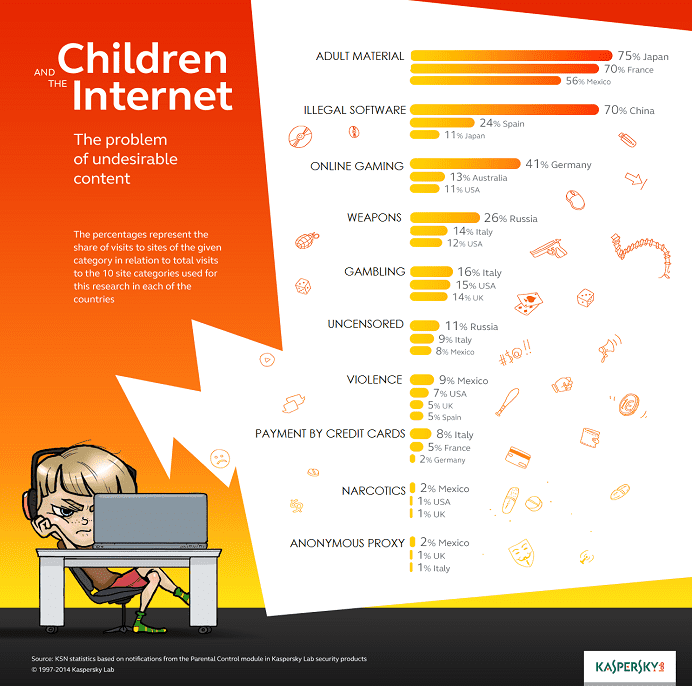
Ten categories of undesirable website content were chosen for the investigation, as follows: adult material, illegal software, narcotics, cruelty and violence, strong language, weapons, gambling, anonymous proxy servers, payment systems, and online games.
In the Middle East 23% of children visit unwanted online game sites many of which can expose the household network to malicious programs and content. Another 19% use proxy servers to access blocked sites in the region, which can be both illegal and dangerous as many spammers look to exploit visitors of these sites.16% download illegal software, visitors to these sites expose themselves to the risk of illegal software malware. The leads in the visit-ratings are based on notifications from Kaspersky Lab’s Parental Control module.
Sites belonging to the category of ‘adult material’ are visited most often in Japan (74.9%) and France (68.9%) which is at high peaks when compared to the Middle East (5%). However, even these low percentages of visits to sites of this category can signal to parents a degree of danger and be a cause for concern. Nevertheless, it’s worth pointing out that sites containing “adult material” are blocked in most of the countries in the Middle East region.
Indicators of other categories
- Strong language: Russia (10.7%), Italy (9%), Mexico (7.7%)
- Gambling: Italy (15.7%) USA (15.4%), UK (13.5%)
- Credit card payments: Middle East (9%), Italy (8.5%), France (5.5
- Sites belonging to cruelty and violence where visited at 8% in the Middle East when compared to 7% in the USA.
- Online games: Germany (41.1%), Australia (13.4%), USA (11.2%)
Commenting on the findings, Anna Larkina, Senior Web Content Analyst at Kaspersky Lab, said: “Besides unwanted content, the Internet brings with it other dangers no less damaging for children, for example cyber-bullying or cyber-trolling. Aggressors can exploit all possible channels of online interaction – including social networks, forums, chats and messengers – which when used together can cause victims untold mental suffering. Technically, the fight against cyber-trolling is not so simple, so Parental Control is not so effective against it. As a rule children are not able to cope with aggressors on their own; therefore, parents have an important role to play in the protection of children from cyber-bullying. Ideally, parents need to pay attention to their children’s Internet activity.”
More information can be found at securelist.com.
[1] Data were taken from KSN statistics based on notifications from the Parental Control module in Kaspersky Lab security products permitting analysis of the categories of undesirable site content which children reach most often. These statistics are collected anonymously, and regardless of whether a given category is deemed dangerous by parents and thus blocked by Parental Control.


